In this review
The old can opener gave up on a Tuesday, halfway through a can of San Marzano tomatoes. The gear spun freely. The blade never punctured. I stood at the counter with a dented can and a half-chopped onion softening off-heat in the pan, and I had that very specific feeling of being defeated by a four-dollar tool. I ended up stabbing the lid open with a paring knife, which is how people lose fingers. Dinner was late. The sauce was fine.
The KitchenAid Classic showed up two days later. I’ve been using it daily for about two months now on everything from crushed tomatoes to tuna in oil to the occasional beer on a hot afternoon. It is a boring, quiet upgrade. That is exactly the point.
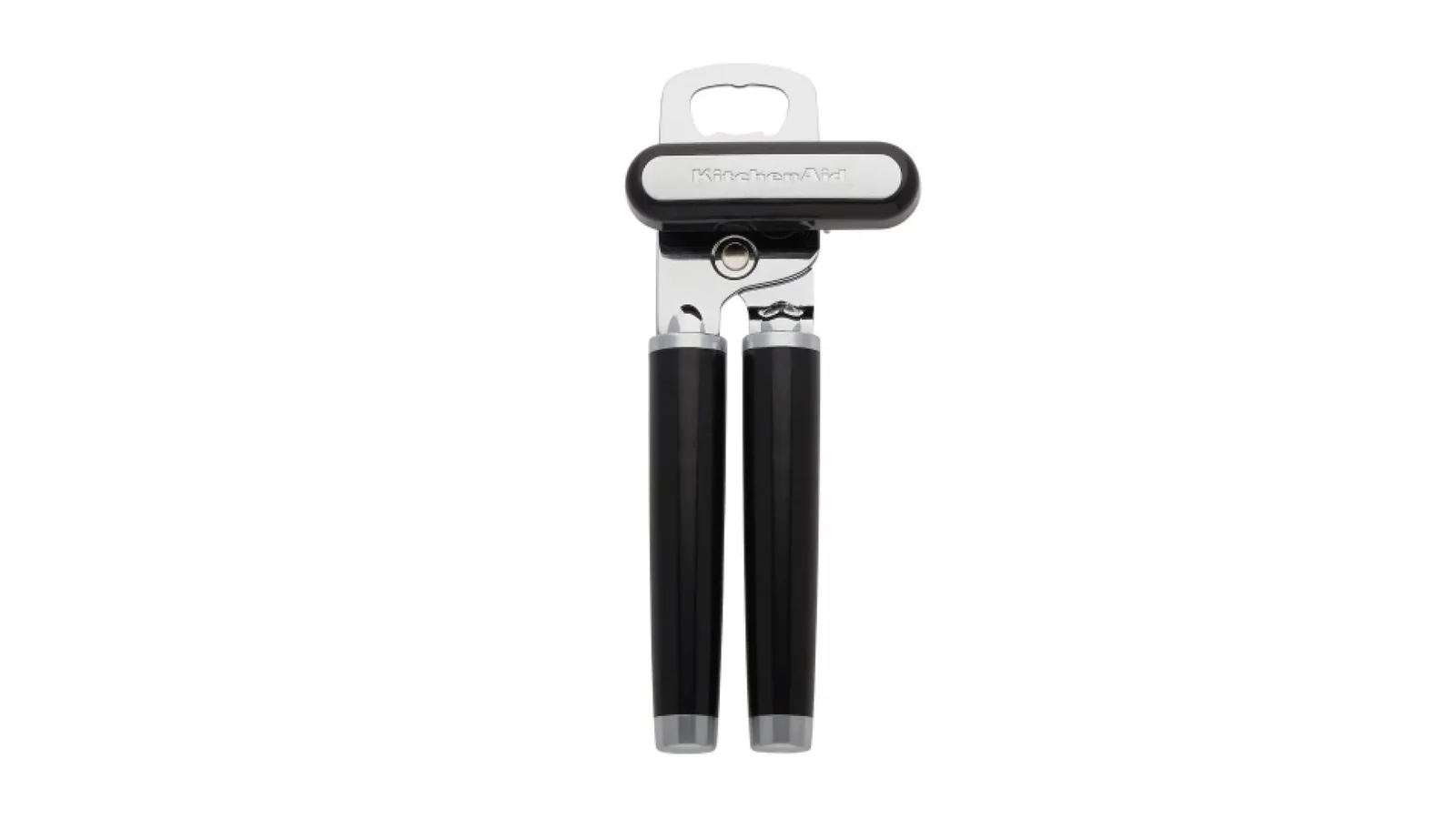
KitchenAid Classic Multifunction Can Opener
A manual can opener with a 420 J2 stainless steel cutting wheel, ABS handles with a chrome-plated collar and stainless endcap, an easy-turn knob, and a bottle opener built into the head. Top-cut style, which means you get the traditional sharp lid rim and a sharp edge on the can itself. Hand wash only, backed by a one-year replacement and lifetime limited warranty.
Rating Breakdown
Rating breakdown
How It Cuts
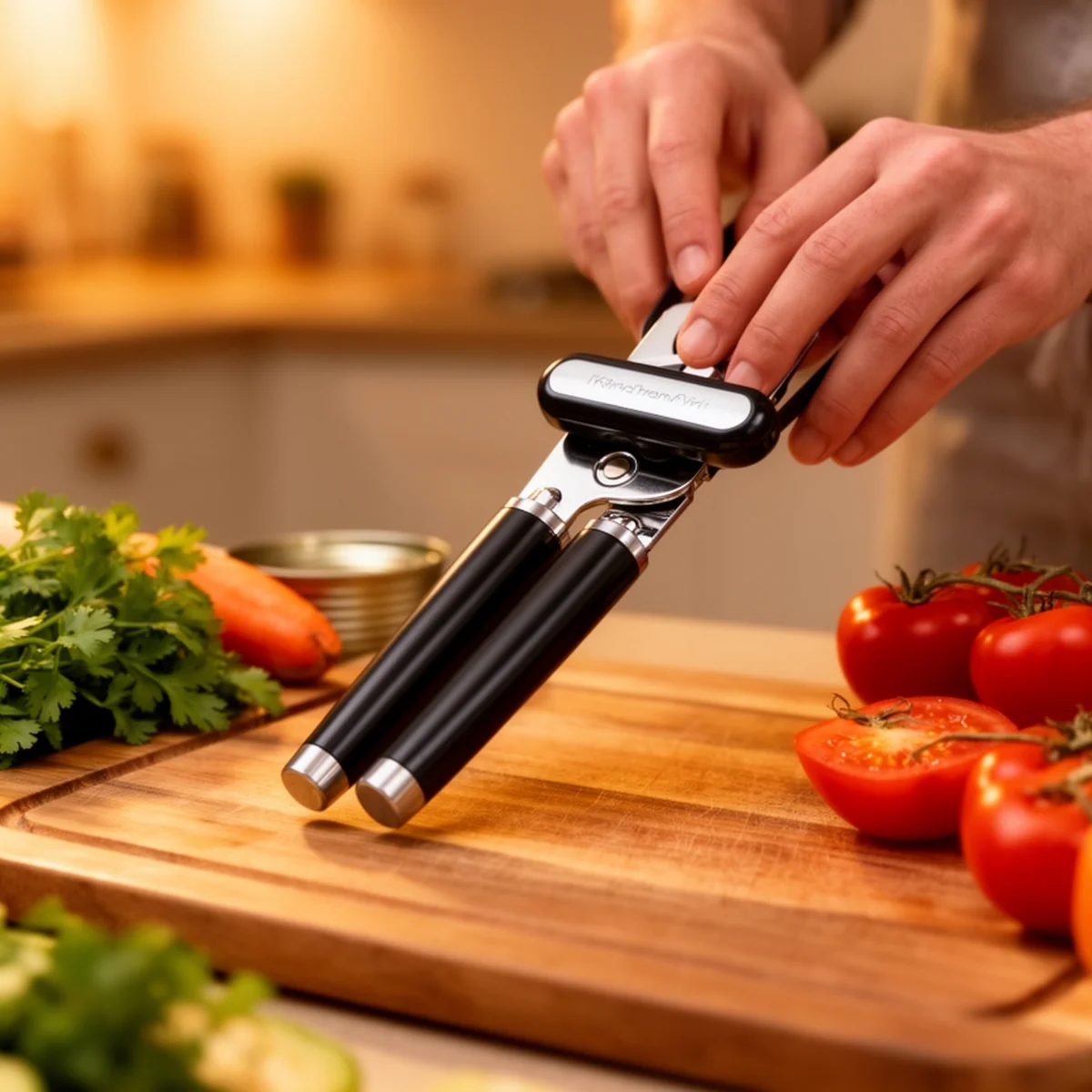
The 420 J2 stainless wheel punches through a lid on the first quarter-turn. That’s the part of this tool that matters most, and it is the part cheap openers fail at first. I tested it on thin-walled cans (tuna, black beans, coconut milk) and on the heavier-gauge soup cans that Campbell’s still makes, and it never skipped a gear. On a standard 28-ounce San Marzano can it opens fully in about nine turns. On a small tuna can, four.
The knob is where the ergonomics earn their keep. It’s large enough that your thumb and index finger rest on it naturally, and the plastic has enough grip that wet hands still turn it. I’ve opened a can with soapy fingers more than once, which is a thing you end up doing during actual cooking, and it never slipped.
The one honest note on cutting style: this is a top-cut opener. It leaves a sharp lid you have to fish out of the can, and the can rim itself has the traditional sharp edge. If you have small kids helping in the kitchen, or you’ve cut yourself on a tuna lid more than twice, you want a side-cut opener instead. Something like the Kuhn Rikon Auto Safety, which costs about ten dollars more and leaves a smooth edge. The KitchenAid is the classic shape for a reason, but the reason is habit, not safety.
The Hand-Wash Problem Nobody Mentions
The fine print says hand wash only. Most buyers read that, shrug, and put it in the dishwasher anyway. I did. My last opener spent three months on the top rack and the gears rusted to the point where the wheel stopped turning. The KitchenAid works the same way. The blade and the gear assembly are stainless, but the pivot points and some of the internal hardware will corrode if you cook them in hot soapy water for an hour at a time.
In the sink, here’s what the real routine looks like. Thirty seconds under hot running water, a quick scrub of the blade and gear with a dish brush, a shake to get water out of the hinge, and set it handle-down on the drying rack so the gears drain. Do that and it lasts a decade. Ignore it and you’ll be back here buying another one in eight months. I learned it the hard way with the last opener. Not learning it again.
For dishwasher households, this is the wrong tool. Get the OXO Good Grips Snap-Lock or the Kuhn Rikon. They’re both dishwasher-safe and they’re both good. The KitchenAid is for people who wash by hand, or at least wash this specific tool by hand.
Grip, Bottle Opener, and the Small Details
The handles are ABS, not metal. They have a glossy finish with a chrome collar at the head that makes the tool look more expensive than it is. After two months the finish is clean, no scratches and no chips. The handles do not feel like the metal on a Le Creuset corkscrew. They feel like plastic. Decent plastic, but still plastic.
The built-in bottle opener is cut into the head of the tool, and it works. I’ve used it for about fifteen beer caps and a couple of stubborn glass juice bottles. It’s not the main reason to buy this, but it is the reason I’ve stopped losing the little separate bottle opener in the junk drawer. One tool, two jobs, no hunting.
The handles squeeze to lock onto the can, which is the correct mechanism. Cheap openers use a wingnut or a lever that you have to clamp down on separately. This one you just squeeze and turn. My partner, who has smaller hands than I do, picked it up on the first try and opened a can of chickpeas without asking how it worked. That is the test.
What Falls Short
This will not help you if your hands don’t have grip strength. It still requires you to clamp and turn, and both motions need working fingers. If arthritis is the reason you’re shopping for a can opener, buy an electric one. Hamilton Beach makes a plug-in model for around twenty-five dollars that does the work for you. The KitchenAid is for people whose hands still work. It’s a tool, and nothing more.
The plastic handles can crack if you drop it on tile. Mine has fallen once, no damage, but I’ve read enough owner reports of the handle splitting at the seam to know it’s a real weak point. Don’t drop it on stone floors.
And the lid itself, after the cut, sits inside the can, which means you have to fish it out with a fork or a magnet or a finger you’ll regret. That is the nature of a top-cut opener. It is not a bug of this specific model. It is the category.
Who Should Buy This
If your current can opener has started to slip, or requires three attempts to break the seal, or has any visible rust, this is the replacement. Nineteen dollars for a tool you use every week is a rate per-use that makes a chef’s knife look expensive. If you cook with canned tomatoes, beans, tuna, coconut milk, or stock more than twice a week, buy this.
If you run the dishwasher aggressively and will forget to wash this by hand, skip it. Get the OXO. Your future self will thank you for the honesty.
If you have kids helping in the kitchen, skip it. Get a side-cut opener. The sharp lid is a real hazard in small hands.
A can opener is the tool in your drawer with the worst ratio of price to daily use. Most of us have been hauling around a broken one for years because it still kind of works, the way a bent fork still kind of works. Replacing mine with the KitchenAid is the kind of small upgrade you forget about after a week, and then one day you open a can in ten seconds and remember what good tools feel like.
For more kitchen tools we’ve tested hands-on, browse our full cookware reviews.
Also featured in
Related reviews

Stanley Quencher vs HydroJug Traveler vs Owala FreeSip: Which Tumbler Actually Fits Your Day
Three tumblers on the prep counter at 6 a.m.: Stanley for the desk braise, HydroJug for the handle carry, Owala for the leak-proof bag toss.
 The Foodie Apr 18
Best Kitchen Essentials Under $40: Seven Small Upgrades That Actually Change How You Cook
Eight months testing seven sub-$40 kitchen tools across sourdough, spatchcocked chicken, and sheet pans. The three that changed how I cook.
The Foodie Apr 18 
Alpha Grillers Meat Thermometer Review: The $13 Truth Teller
I tested this $13 instant-read thermometer for six weeks on everything from roasts to caramel. It reads in 2 seconds and never left me guessing.
The Foodie Apr 15 
Etekcity Digital Kitchen Scale Review: A $20 Workhorse
This $20 scale survived eight months of sourdough, coffee dosing, and one full espresso spill. Still reads to the gram.
The Foodie Apr 15 
Etekcity Kitchen Scale: Best Value Under $14
The $14 Etekcity does 90% of what a $55 OXO does. I tested accuracy with calibration weights and ran the cost-per-use math.
 The Budget Hunter Apr 15
HydroJug Traveler 32oz Review: The Cup-Holder Water Bottle Worth the Counter Space
Flip straw, one-hand drinking, ice that survives an eight-hour cook—this $49 bottle earned its counter space.
The Foodie Apr 15