In this review
The barn cat who lives two houses down has taken me about nine months to befriend. I do not own her. Nobody does. She eats on my back step in the morning and disappears by noon. Last December I tore the corner off a tube of INABA Churu and squeezed a thin ribbon onto the concrete about three feet from where I was sitting. She approached. She licked the whole line. Then she sat down, about a foot from my knee, and let me exist. That was the first time.
I am not going to overclaim here. One tube of cat purée is not a socialization protocol. But I had been reading the Amazon reviews for weeks before that, and one line kept showing up from feral-cat caretakers: the tubes crack the shell. One five-star review put it bluntly: “My feral cats love Churus to the point many finally let me pet them.” I believe it now, because I have watched it work.
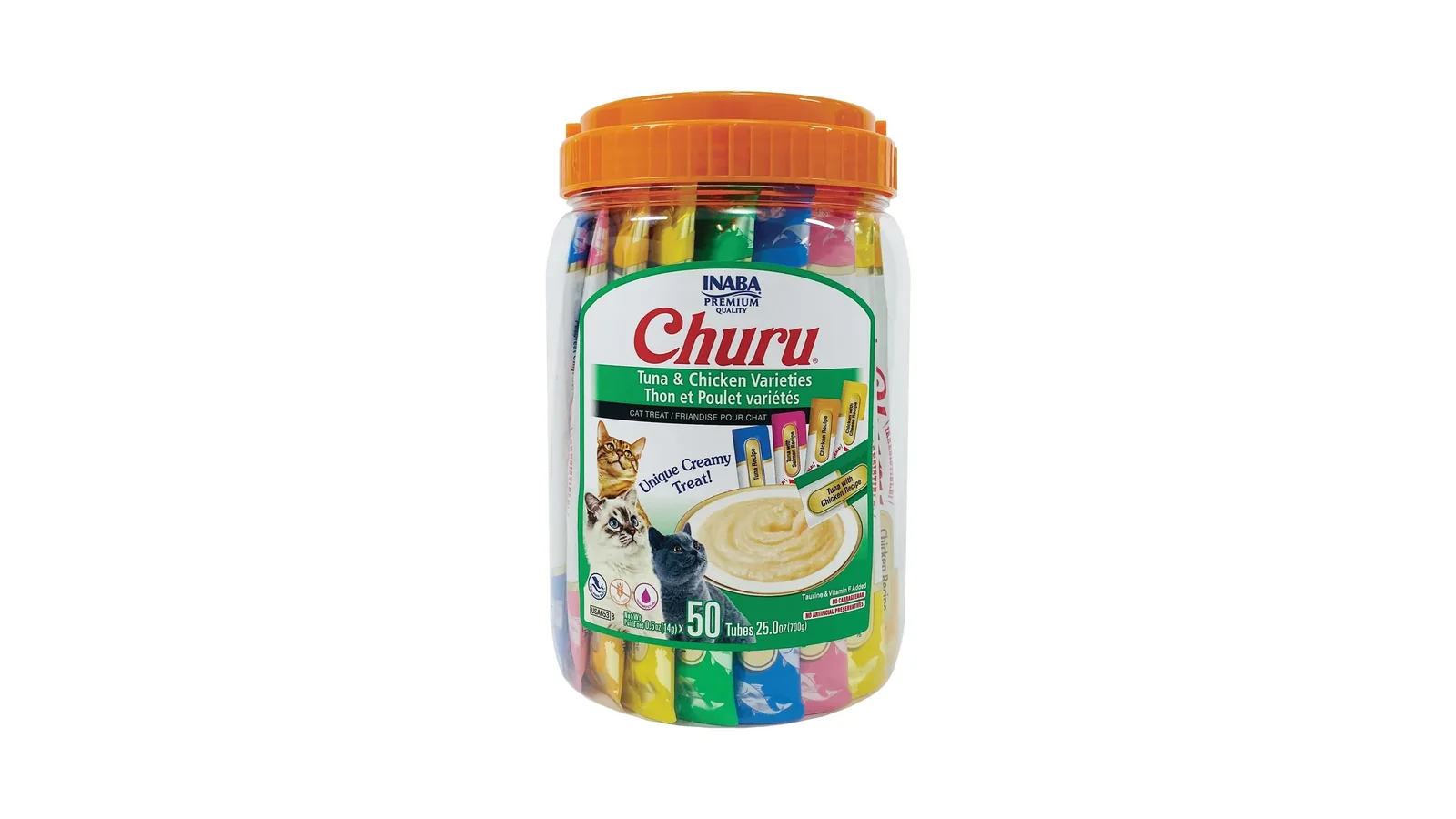
INABA Churu Cat Treats Creamy Purée Variety Pack, 50 Tubes, Tuna & Chicken
Fifty 0.5 oz lickable tubes of tuna and chicken purée. 91% moisture, roughly 6 calories per tube, grain-free, no carrageenan, added taurine and vitamin E. Box runs around $38 which works out to about 77 cents per tube. Made in Japan by INABA, a company whose primary business is human-grade tuna. No artificial colors or preservatives in this variety.
Rating breakdown
Palatability: the universal yes
I have fed Churu to three cats. My 11-year-old tortoiseshell, who turns her nose up at most wet food if the texture is even slightly off. My four-year-old gray tabby, who will eat just about anything. And the barn cat, who has no reason to trust me. All three go at it like it is the last thing they will ever eat.
That is not a flourish. Every owner I have talked to reports the same reaction, and the Amazon reviews say it at volume across 12,000+ ratings. One that stuck with me: “My male cat does not like wet food at all, so I wanted a way to get him extra fluids. I was very surprised how much he actually likes these.”
Here is what I think is going on. The purée is warm-temperature stable and has a strong smell (tuna-forward, even in the chicken tubes). Cats eat with their nose more than their tongue, and the aroma on these is aggressive in a way a sealed can of wet food is not. You tear the corner, the room changes. The cat is already at your feet.
Hydration delivery: the actual reason to buy these
This is the part I want pet owners paying attention to. Cats are desert animals by evolution and terrible at drinking water. Chronic low-grade dehydration is one of the quieter contributors to kidney disease in older cats, and by the time you see symptoms you are already managing a condition instead of preventing one.
Each tube is 91% water. Six calories. That is a meaningful fluid bump you can deliver once or twice a day on top of their regular food, and because the cat thinks it is a treat, no fight is involved.
My tortoiseshell has early kidney numbers that the vet is watching. I do not give her Churu as a treat. I give it as hydration with flavor. Half a tube in the morning, half at night. Over four months her water intake from the bowl has not changed, but her total fluid intake has gone up measurably because I am adding about 13 grams of water per tube, twice a day. Her last bloodwork was slightly better than the previous panel. I am not going to say the tubes caused that. I am going to say they are the cheapest hydration intervention I have tried that the cat will tolerate, by a wide margin.
Ingredient quality: better than most treats, honest about the gaps
I ran the ingredient framework on this one.
First five ingredients for the tuna tube: tuna. Water. Tapioca starch. Chicken. Then natural flavor. The chicken tube leads with chicken instead. Both are genuinely protein-first with whole named proteins, not “meat byproducts.” That alone puts Churu ahead of about 80% of the treat aisle.
The full deck adds taurine (cats cannot synthesize their own and will go blind and develop heart disease without it), vitamin E as a natural preservative, and green tea extract for the same reason. What is not in there matters too: no grains, no corn, no soy, no carrageenan, no artificial colors, no BHA or BHT.
Gaps worth naming. Sodium is moderate for a treat, which is fine at tube-or-two-per-day but not a reason to give a cat ten tubes. The guaranteed analysis is low on fiber, so these will not help a cat with constipation issues. And a tube is a treat, not food. The label is clear that Churu is a complementary food, not AAFCO-compliant as a complete diet. If somebody tells you their cat “eats Churu for meals,” that cat is malnourished.
Pill-hiding utility: the unexpected superpower
I discovered this accidentally. My gray tabby had a short course of antibiotics last fall, the kind of chalky tablet that you can crush but the cat can taste from across the room. I tried peanut butter (he is not a dog), I tried cream cheese, I tried hiding it in a meatball of canned food. He found the pill every time, spat it out, and gave me the look cats give you when they feel personally betrayed.
On day four I crushed the pill into about a third of a Churu tube, mixed it with the end of a chopstick, and offered it in a small shallow dish. He licked it clean in about twenty seconds and asked for more. The tuna smell is strong enough to mask bitter medication, and the purée texture suspends crushed pills evenly without leaving powdery pockets. Every vet tech I have mentioned this to nods knowingly. This is a known trick.
For pilling cats, Churu earns its price on medication week alone.
Real-world testing: four months of tubes
I have gone through about 40 of the 50 tubes in the box. The box includes plain tuna, plain chicken, tuna-and-chicken, plus tuna-and-scallop. That variety has kept things interesting, but honestly none of my cats have a strong preference. They eat what is offered. I rotate to keep from running out of any one flavor before the others.
A few practical notes from actual use. The tubes tear cleanly from the notched corner without scissors. Hand-feeding works well with house cats who trust you, and it is where the real bonding happens, but the ribbon-on-a-plate method is what I use when I am cooking or working. Do not squeeze the tube onto a porous surface (rug, wood floor). The purée soaks in fast and you will be scrubbing. A ceramic saucer is the correct answer.
The tubes are shelf stable until opened and the box stores flat in a drawer. Once opened, a tube should be used same-day. Half tubes stored in the fridge for later-in-the-day feeding are fine. Don’t try to save a tube overnight.
What could be better
The packaging waste bothers me. Fifty individual plastic tubes plus foil seals is a lot of trash for what amounts to about 25 ounces of food. I wish INABA offered a bulk pouch format for the tubes-are-the-vehicle owners who do not need the single-serve portioning. They do not, yet.
The price per ounce is genuinely steep. At roughly $1.55 per ounce for purée, this is not cheap cat food. You are paying for the delivery format and the ingredient deck, not the tuna itself. Treat it as what it is: a treat and a hydration tool, not a staple.
And the obsession factor is real. Once a cat learns what the packaging sounds like, you will be followed. My tortoiseshell has developed an auditory radar for the specific crinkle of the box opening from two rooms away. If you value a quiet life, introduce these slowly.
Who should buy the 50-tube variety pack
Multi-cat households, absolutely. The variety rotation prevents flavor fatigue, and at three cats you will go through the box in about a month.
Single-cat households with a cat who has any of the following: picky eating, low water intake, early kidney markers, upcoming medication course, dental issues that prevent hard food, or any history of food aversion during stress. In all those cases Churu is a tool, not a treat.
If you have one easy-going cat who eats everything and drinks plenty of water, buy a 4-tube or 20-tube box first and see if your cat likes the format before committing to 50. Some cats genuinely do not care for the texture. Individual variation is real. But across three very different cats in my orbit, the hit rate has been 100%, and the reviews suggest that is closer to the average than the exception.
For more cat product reviews, check out our complete cats category.
Also featured in
Related reviews
Fresh Step vs Dr. Elsey's Ultra: A Clumping Cat Litter Showdown
Two clumping clays, one two-cat apartment, four weeks of scooping. Charcoal-plus-fragrance against vet-recommended bentonite.
 The Pack Leader Apr 18
Best Cat Care Essentials: Litter, Food Toppers, and What Earns a Repeat Order
Three cat staples tested across two house cats: the grocery-aisle clumping litter, the vet's litter-strike fix, and the tubes that earn recall.
The Pack Leader Apr 18 
Dr. Elsey's Ultra Unscented Clumping Cat Litter Review: The 40lb Bag Worth the Carry
The 40lb bag that stopped my older cat's litter box strike in two days. Concrete clumps, zero perfume, vet-formulated for picky cats.
The Pack Leader Apr 15 
Fresh Step Multi-Cat Odor Control Litter Review: The Grocery-Aisle Workhorse
Activated charcoal, clay clumps, and a 14-pound jug that fits in most closets. Fresh Step Multi-Cat, tested in a two-cat apartment across months of scooping.
The Pack Leader Apr 15 
Nutramax Cosequin Joint Health Supplement for Dogs Review
The #1 vet-recommended joint supplement for dogs, with over 78,000 reviews and 25 years of use. Here is what my dogs and the science actually showed.
The Pack Leader Apr 19 
Best Dog Owner Starter Kit: Five Products That Earn Their Spot on the Leash Hook
Five dog essentials tested across cold walks, two tick seasons, puppy accidents, muddy returns, and 360 pills. What earns a spot on the leash hook.
The Pack Leader Apr 18